Forestry Trucks: The Complete Guide to Forestry Equipment, Uses, Types & Buying
Walk onto almost any tree service lot, utility yard, or municipal forestry depot and you’ll see the same thing: a lineup of tall, boxy trucks with buckets, chip boxes, and booms folded up like sleeping cranes. These are forestry trucks, and they’re the backbone of an industry most people never think about until a storm knocks a branch through their roof. If you’re buying, renting, or just trying to understand this equipment category, this guide covers everything you need. Let’s get into it.
What Are Forestry Trucks?
A forestry truck is a work vehicle built specifically for tree care, vegetation management, and timber-related jobs. Most people picture a bucket truck, but the category is much bigger than that. At its core, a forestry truck combines three things: a chassis strong enough to carry heavy gear, a specialized body like a chip box or dump bed, and often an aerial lift or crane attachment. The goal is always the same — get workers and tools where they need to be, safely, and haul away whatever debris the job creates.
The forestry equipment market isn’t small either. A report by Global Market Insights found the global market valuation for forestry equipment will pass $17 billion by 2026, driven by rising demand for timber harvesting and vegetation management. That growth shows up directly in how many of these trucks you see on the road.
Why Forestry Trucks Are Essential
Trees don’t stay put, and they don’t cooperate. Branches grow into power lines. Storms drop entire canopies onto roads overnight. Someone has to get up there, cut it down, and haul it away safely, and fast.
That’s the job forestry trucks exist to solve. Specialized forestry trucks let crews complete jobs faster by combining multiple functions in a single vehicle, which makes them essential equipment for professional tree service companies. Instead of one crew climbing with ropes and saws, another crew running a separate chipper, and a third truck hauling debris, one well-built forestry rig can do most of that work itself.
There’s also a safety argument worth mentioning. Before bucket trucks became standard, tree work relied heavily on climbing spikes and ladders, which are still riskier than a stabilized aerial platform. An aerial device puts a worker in a fixed, protected bucket instead of hanging from a rope forty feet up. That difference matters a lot when things go wrong.
Types of Forestry Trucks
Forestry trucks aren’t one product — they’re a family of vehicles, each built for a different piece of the job. The main categories include forestry bucket trucks, chipper or chip-body trucks, grapple and log loader trucks, forestry service trucks, forestry dump trucks, and forestry fire trucks. Each one solves a different problem, from lifting workers into the canopy to hauling logs off a job site.
The forestry industry runs on specialized iron, and not every truck is built to do every job. Choosing between a bucket truck, a chipper truck, or a grapple/log loader truck depends on your company’s work mix, crew size, and disposal setup. A residential tree company trimming suburban yards has very different needs than a utility contractor doing right-of-way clearance along transmission lines.
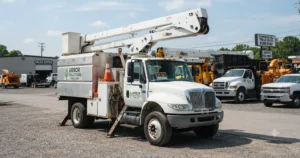
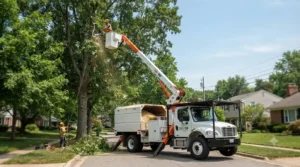
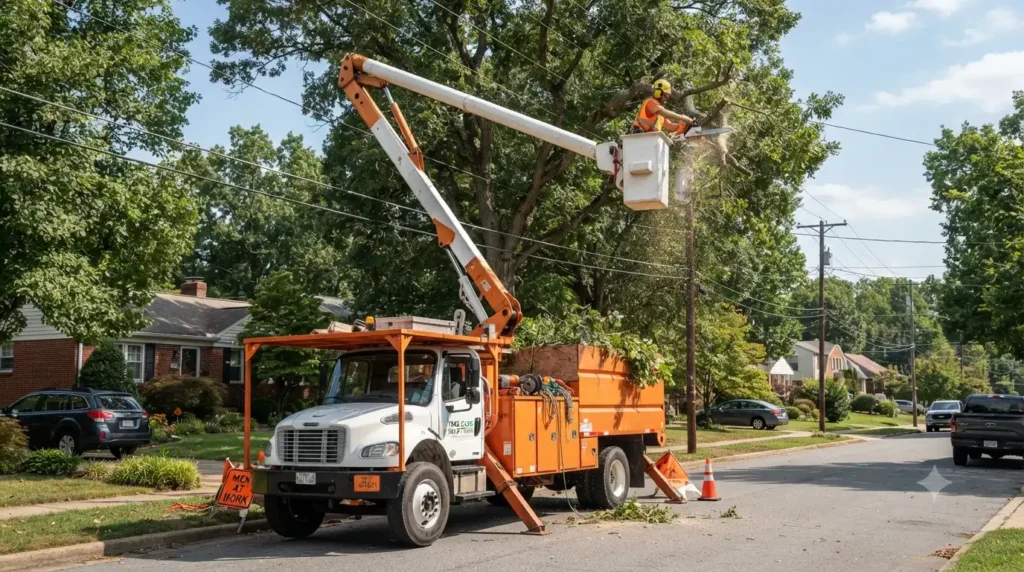
Forestry bucket trucks are the workhorse of the industry — the truck most people picture when they hear “forestry truck.” They use a hydraulic boom and platform to lift crews safely into the canopy, with configurations ranging from chip-body units (aerial lift plus a chip box for trimming and hauling in one vehicle) to rear-mount models built purely for pruning and removal. For a full breakdown of boom types, working heights, and specs, see our complete guide to forestry bucket trucks.
Forestry service trucks are the support vehicles that keep everything else running. They carry fuel, tools, hydraulic fluid, and spare parts out to job sites so a crane, chipper, or bucket truck doesn’t have to shut down over a minor mechanical issue. Think of them as the pit crew of a forestry fleet — when a chipper blade snaps thirty miles from the shop, a service truck with the right parts and a mechanic on board is the difference between losing an hour and losing a day.
Forestry dump trucks handle the heavy hauling — logs, mulch, gravel, and bulk debris that a chip box can’t handle efficiently. Built on heavier chassis than standard bucket trucks, with reinforced dump beds, they matter most in land-clearing and larger logging operations where the volume of material moved each day is measured in tons, not cubic yards.
Forestry fire trucks, often called wildland engines or brush trucks, are a category that gets less attention but is critical to state forestry departments, national forest agencies, and volunteer fire districts. Built smaller, lighter, and far more maneuverable than a standard structural engine, they’re designed to reach dirt roads and rough terrain a full-size pumper can’t handle. Most run on a mid-size 4×4 or 6×6 chassis with a smaller water tank — often 200–750 gallons versus the thousands carried by a structural engine — plus a front- or rear-mounted pump for quick deployment on initial wildfire attack.
How Forestry Trucks Work
Under the hood, and under the chassis, a few systems do all the heavy lifting — literally. Hydraulics run the show: the hydraulic lift system powers the bucket platform and allows workers to reach elevated areas. The same hydraulic circuits often power outriggers, grapples, dump beds, and PTO-driven tools as well.
PTO, or power take-off, pulls power directly from the engine to run hydraulic pumps, chippers, and cranes without needing a separate motor. This is exactly why chassis selection matters so much — medium-duty trucks need to provide the durability, payload capacity, and serviceability required for forestry work.
Stabilization systems, like outriggers and A-frame supports, keep the truck steady while a boom is extended sideways or overhead. Without them, a fully extended boom would risk tipping the entire vehicle. It’s a simple safeguard, but it’s the one thing that keeps a 60-foot lift from becoming a serious hazard.
Industries That Use Forestry Trucks
Tree service companies are the obvious buyers, but they’re far from the only ones. Utility companies use forestry bucket trucks to trim trees around power lines, which helps prevent outages caused by falling branches. Municipalities use bucket trucks to trim trees in parks, along roads, and near public buildings, while landscaping companies sometimes use them for general property maintenance.
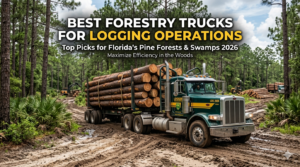
Storm cleanup crews use forestry trucks to remove fallen trees and clear roadways after storms or natural disasters. Logging and timber operations rely on transport-focused forestry trucks to move logs from forest to mill. State and federal forestry agencies use fire-adapted trucks for wildland fire response and prescribed burns.
Here’s a good example of how these pieces fit together. After a major ice storm knocks out power across a county, it’s usually not one truck doing the work — it’s a coordinated fleet. Utility crews send bucket trucks to clear lines, municipalities dispatch grapple trucks to clear roads, and contractors bring in chipper trucks to process the debris. Municipalities and contractors who must deliver quick storm response often build grapple trucks into their fleet specifically for reliability and speed.
Key Components of Forestry Trucks
A few components separate a purpose-built forestry truck from a generic work truck. The aerial lift or boom comes in two styles: articulating, with multiple joints that let workers maneuver around branches and obstacles in tight spots, or telescopic, with a straight arm built for maximum reach. The chip box generally holds 10–30 cubic yards, depending on whether the chassis is light-duty or heavy-duty.
Beyond that, a cab guard — also called a FOPS, or falling object protection system — is standard on most forestry bucket trucks to protect the crew from falling branches. Outriggers provide stability during lift operation, and lockable tool storage keeps saws, rigging, and PPE organized and secure. Many trucks also come with an optional winch, useful for pulling logs or freeing stuck vehicles.
Safety Standards and Regulations
Forestry trucks with aerial lifts fall under a specific set of national standards, and this is one area where a lot of buyers get caught off guard. The governing standard covers vehicle-mounted aerial devices, including extendable and articulating boom platforms, and ladders and towers mounted on trucks, trailers, and all-terrain vehicles. Its purpose is to prevent accidents and injuries by standardizing ratings for aerial lifts and making sure everyone in the chain understands their responsibilities.
This isn’t just paperwork. Fleet managers are generally expected to know these rules, because the standard can hold owners of aerial lifts liable for equipment they sell or lease in certain scenarios. If you’re buying a used bucket truck, ask directly about its current inspection status and boom certification — a truck without recent documentation is a liability risk, not a bargain.
Beyond the lift itself, most forestry operations also need to think about a few other rules. Trucks with a Gross Vehicle Weight Rating over 26,001 lbs generally require a Class B commercial driver’s license, which is why many forestry trucks are intentionally built just under this threshold. Insulated booms used near power lines need periodic dielectric testing to confirm they still provide electrical protection. Fall protection matters too — some manufacturers now build in warning systems that trigger if an operator elevates the bucket without a safety harness lanyard attached.
Forestry Truck Maintenance
A forestry truck earns its keep by staying on the road, not sitting in the shop. A few maintenance basics matter more here than on a standard work truck. Annual, or more frequent, boom inspections catch cracks, hydraulic leaks, and worn pins before they become safety failures rather than cosmetic issues.
Hydraulic fluid checks matter too, since the lift, outriggers, chipper feed, and dump bed often share hydraulic circuits. A slow leak in one system can quietly affect several others without anyone noticing right away. PTO and clutch inspections are important as well, since PTO systems see heavy daily cycling and wear shows up faster here than on a typical fleet vehicle.
Chip box and dump mechanism servicing rounds things out, since hinges, dump cylinders, and tailgate latches take a beating from debris and need regular lubrication. Chassis-level service on brakes, tires, and suspension is also non-negotiable, because these parts wear faster on forestry trucks due to constant stop-start driving and heavy loaded weight. With proper maintenance, a quality unit can serve reliably for years in the field.
How to Choose the Right Forestry Truck
Before you compare brands or prices, answer three questions honestly.
What’s your primary job mix?
A company doing 80% residential trimming needs different specs than one running utility right-of-way clearance or storm response contracts.
What height and reach do you actually need?
Bucket trucks typically fall into three categories: less than 50 feet, 50–59 feet, and over 60 feet. Going bigger than necessary adds cost and reduces maneuverability on tight residential streets, so bigger isn’t automatically better.
Do you need CDL flexibility?
If your driver pool doesn’t hold commercial licenses, staying under the 26,001 lb GVWR threshold widens who can legally operate the truck.
From there, work through a practical checklist: boom type, chassis class and payload capacity, chip box size versus your average debris volume, and winch or jib needs. Brand reputation matters too — Terex Hi-Ranger and Altec remain two of the most recognized manufacturers in forestry aerial lift equipment, each offering dependable double over-center boom configurations for demanding field use.
Ready to start shopping? Pricing, financing, and used-vs-new tradeoffs vary widely depending on boom type, condition, and CDL requirements — our complete forestry trucks for sale guide breaks down real pricing, rental rates, and a buyer’s checklist for new and used equipment.
Frequently Asked Questions
Q: What’s the difference between a forestry truck and regular work truck? A forestry truck is purpose-built with a specialized body — an aerial lift, chip box, dump bed, or grapple — designed specifically for tree care, vegetation management, or timber work, rather than general hauling.
Q: What industries use forestry trucks besides tree services? Utility companies, municipalities, landscaping companies, logging and timber operations, and state or federal forestry agencies all rely on forestry trucks for different parts of vegetation management and storm response.
Q: How long does a forestry truck last with proper care? With proper boom and hydraulic maintenance, a well-kept unit can stay productive for well over a decade.
Q: Do I need a CDL to drive a forestry truck? Only if the truck’s GVWR exceeds 26,001 lbs; most forestry trucks are built under that limit specifically to avoid the requirement.
Q: What size chip box do I actually need? Most chip boxes range from 10 to 30 cubic yards, depending on your crew size and job volume.