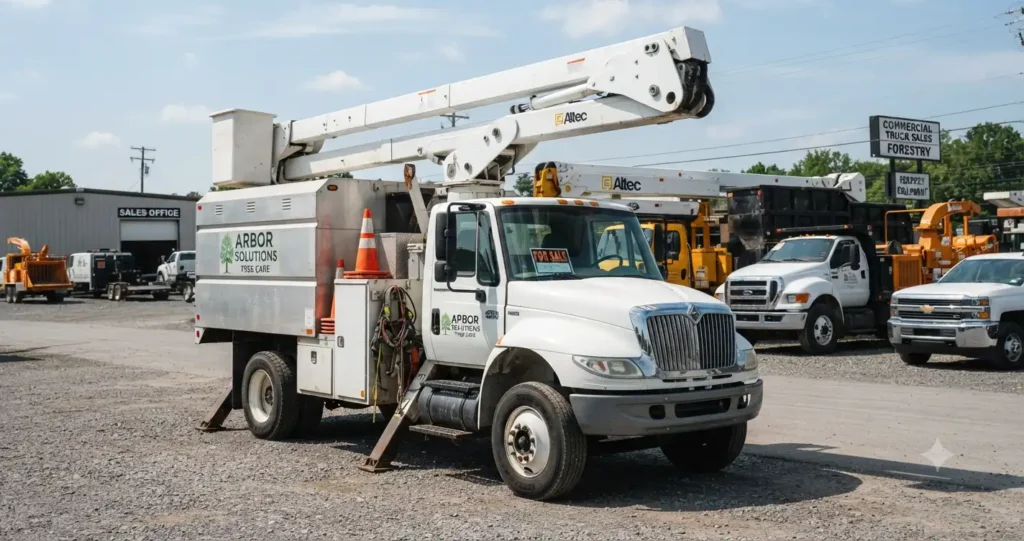
A standard forestry bucket truck will get your crew off the ground. But if you want your team to stay safe once they’re up there and you want the truck to actually earn its keep on busy job days, a few critical upgrades make all the difference. This guide walks through the upgrades that matter most when building out a new forestry bucket truck for tree care work, why each one matters, and how to think about the cost. For fleet owners and operations managers, speccing a new truck is a major decision. Getting the configuration right from day one is the key to long-term ROI, crew safety, and a competitive edge in a rapidly growing industry.
Why Do Tree Care Fleets Need to Prioritize Bucket Truck Upgrades?
Tree care is one of the most dangerous jobs in the country. Workers in this field face a fatality rate estimated to be as high as 30 times the all-industry average, a statistic driven by the unique and severe hazards of the job. While the Bureau of Labor Statistics does not have a specific code for “tree workers,” the closest proxy, “building and grounds maintenance,” already shows a fatality rate double the national average, and industry experts agree that tree care is significantly riskier than that.
The accidents behind these numbers follow a few distinct patterns. An analysis of 243 fatal incidents between 2020 and 2023 revealed that most deaths fall into just three categories: “Contact with Objects and Equipment,” “Falls, Slips, and Trips,” and “Exposure to Harmful Substances or Environments.” These are not random events. They are often a gap in how the truck was built, equipped, or operated. That is the real argument for treating upgrades as part of the truck’s core build, not extras you add later if the budget allows. Almost everything covered below ties back to one of these failure points, starting with how the platform itself is protected.
What Chip Box or Debris Body Options Should You Choose?
The chip box is more than storage space. It’s a weight decision that affects everything else you bolt onto the truck. Steel boxes are tougher and cost less up front, but they add a lot of weight low on the chassis. Aluminum costs more but frees up payload for other upgrades, which matters once you start adding outriggers, material handling gear, and a full chip box on the same frame. For instance, a typical build might feature an 11-foot chip box, which is a common configuration for maximizing debris capacity without overextending the wheelbase.
Body style matters too. A dump body speeds up unloading on jobs where debris piles up fast, while a flatbed stake body gives you more flexibility for hauling gear. Length is worth watching closely as well. A longer box holds more but stretches the wheelbase, making the truck harder to turn on narrow residential streets. Crews working mostly in tight neighborhoods often give up some capacity for a shorter, more maneuverable truck, while crews doing municipal or utility work can usually afford the extra length. A bigger chip box adds weight low on the frame, and that’s exactly why your outriggers need to be sized for the fully loaded truck, not just the base chassis.
What Aerial Device Configuration Is Right for Your Fleet’s Work?
The boom decides what jobs your truck can actually handle. Working height, horizontal reach, and mount type all need to match the work your crew does every day, not the numbers that look best on a spec sheet. Modern forestry units now offer working heights up to 75 feet or more, with configurations like the Versalift VO260 reaching 65 feet and the Terex XT Pro 60/70 offering up to 75 feet. For most residential and light commercial work, horizontal reach matters more than raw height. It’s what lets your crew access a canopy over a house or between two properties without repositioning the truck every few minutes. A model like the VST-55-I, with a 59.5-foot working height and 33.9 feet of side reach, is a prime example of a balanced configuration for many tree care applications. For a closer look at how these configurations stack up against each other, our guide on forestry bucket truck types, features, and working heights breaks it down in more detail.
Mount type is the other big decision. A reverse-mounted overcenter boom, set right behind the cab, is built for taller forestry and line clearance jobs, while rear-mounted setups tend to be easier to maneuver in tight spots. Articulated telescopic booms give you even more flexibility, letting operators work around fences and structures or approach a branch from underneath. A taller, longer-reach boom only stays safe if the stability underneath it can handle the load, which is where outriggers come in.
How Do Outriggers and Stability Systems Protect Your Crew?
Outriggers aren’t something you pick once and forget about. They need to match the aerial device’s rated lift capacity. An outrigger setup built for a lighter, shorter boom won’t hold up once you’ve added a taller unit and a heavier chip box behind it. A-frame outriggers are standard on most forestry bucket trucks and give the platform a wide, stable base. If your crews work uneven residential lots, rural land, or sloped job sites, look at slope-compensating systems like the SlopeMax feature offered by some manufacturers, which adjusts for grade instead of assuming flat ground. Undersized or poorly deployed outriggers show up again and again in tip-over incidents. This isn’t the place to cut corners by matching outriggers to the base truck instead of the fully upgraded one.
Stability keeps the truck upright, but the person in the bucket still needs direct protection if something goes wrong at height.
What Fall Protection and Platform Safety Systems Are Worth Adding?
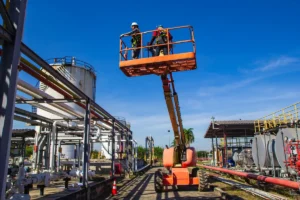
Falls from the bucket are one of the biggest causes of death in tree care work, and the pattern is almost always the same: an operator reaches too far and isn’t wearing a harness, or isn’t clipped in. This is the upgrade with the clearest link between what you spend and what you prevent. At a minimum, every forestry bucket truck should have a boom-mounted anchor point rated for a harness and lanyard, placed so the operator can stay connected while moving around the full platform.
On top of that, secondary barrier systems like TruGuard add another layer of protection right at the platform and cut down the chances that an overreach turns into a fall. Hydraulic tool ports at the platform are worth adding too, since they let the operator run tools without leaning out to reach a power source. Protecting the operator covers falls, but a lot of crews also need the truck to move material, not just lift a person.
Which Material Handling Attachments Increase Fleet Productivity?
A truck that can only lift a person up and back down leaves a lot of work on the table. Attachments like grapples, jibs, and winches let one truck load and clear-cut limbs without needing a second person on the ground managing the debris. Grapple saws make the biggest difference on line clearance and larger removal jobs since the operator can cut and control the piece right away instead of dropping it and hoping the ground crew is clear. Jib and winch add-ons take it further, giving the truck a way to lift and reposition heavier sections. For example, a Versalift unit can be configured with an integrated elevator and winch for heavy-duty lifting. This difference decides how much work one truck and operator can get through without extra crew. If you’re still weighing which body style and attachment combination fits your operation best, our guide to choosing the right forestry vehicle for your operation is a useful next stop.
All of this adds weight and hydraulic demand, which brings us to the chassis and drivetrain, the part of the truck that has to support everything else.
What Chassis, PTO, and Payload Factors Should You Confirm Before Upfitting?
Every upgrade we’ve covered so far, the chip box, the outriggers, and the material handling gear, pulls from the same shared budget: the chassis payload rating and the hydraulic capacity of the power take-off (PTO) system. Get this wrong and you won’t see one obvious failure. You’ll just end up with a truck that’s slightly overloaded across five different upgrades at once. For example, a build using a Ford F-600 or an International MV 607 chassis requires careful coordination to ensure the GVWR and PTO specs handle the combined weight and power demands of all attachments.
The PTO powers the hydraulics for the boom, outriggers, and any attachments, so its capacity needs to be checked against everything you plan to add, not just the aerial device by itself. Wheelbase is the other thing to lock down early. A longer wheelbase supports a bigger chip box but hurts maneuverability, which matters more if your crews work tight urban routes than if they’re mostly on municipal or highway-adjacent jobs. The simplest approach is to spec the chassis and PTO for the fully upgraded truck you’re planning to build, not the bare configuration before any upfits go on. If you’re also deciding between a purpose-built forestry chassis and a standard work truck platform, our comparison of forestry trucks versus regular trucks covers the key differences.
Chassis and hydraulics take care of the mechanical side of safety. Insulation handles the electrical side, and that matters the moment your crew works anywhere near power lines.
Do you need an insulated or dielectrically rated boom?
If your crew works anywhere near energized lines, which covers most line clearance jobs and a fair share of general tree work, a dielectrically tested, insulated boom isn’t optional. Accident reports and OSHA citations repeatedly show boom-to-power-line contact as a leading cause of serious injury and death, often when the crew didn’t realize how close they actually were. Dielectric testing confirms the boom can make contact with an energized line without sending current through to the operator or the truck. A non-insulated boom is fine for work that’s confirmed to be well away from power infrastructure, but for any fleet that takes on utility-adjacent jobs, even occasionally, an insulated boom takes the guesswork out of it. The extra cost is real, but it’s small next to the risk of running an uninsulated unit into a job that turns out to be closer to live lines than expected.
Insulation cuts down electrical risk on the job. The next layer of protection is making sure the truck gets inspected and stays compliant on a regular schedule.
What Compliance Standards and Inspections Should Guide Your Upgrades?
Every upgrade in this guide should be measured against a baseline, and that baseline comes from ANSI Z133 and OSHA. ANSI Z133 works as the tree care industry’s rulebook, covering everything from fall protection requirements to safe procedures around aerial devices. OSHA regulates aerial lift use more broadly, and violations often cite a failure to follow these standards. For example, an OSHA citation against the City of Phoenix noted a failure to provide adequate training and maintain proper inspection checklists as required by ANSI standards.
Compliance isn’t something you check off once at the time of purchase. Dielectric ratings fade over time and need regular retesting. A boom that passed inspection last year isn’t guaranteed to pass this year without being retested. Building your maintenance and inspection schedule around these standards, instead of treating them as a one-time formality, is what actually keeps an upgraded truck delivering the safety it was built for.
Which Technology Upgrades Improve Fleet Efficiency and Safety Tracking?
Once the core safety and capability upgrades are locked in, technology is where fleets pick up real efficiency gains and better visibility across their trucks. Telematics and GPS tracking let fleet managers keep an eye on vehicle location, hydraulic cycle counts, and maintenance schedules across the whole fleet instead of relying on separate service records for each truck. For instance, modern ePTO (Electric Power Take-Off) systems allow a truck to operate on battery power for over 80% of the workday, reducing fuel costs and engine wear.
LED work lighting stretches out safe working hours into early mornings and evenings, which matters most during storm season when daylight is the biggest limit on how much a crew can get done. Backup and side cameras help operators maneuver a longer, chip-box-equipped truck through tight streets without depending entirely on a spotter. None of this replaces the core safety systems covered earlier. These are add-ons that tend to pay off most once a fleet already has the fundamentals in place.
How Do These Upgrades Perform During Storm Response Work?
Storm and emergency line clearance work puts every upgrade in this guide to the test at the same time. A truck that handles routine residential trimming just fine can still come up short during storm response, when chip capacity, stability, insulation, and lighting all get pushed to their limits at once, often for hours on end. This is why municipalities and utility contractors building dedicated storm response fleets tend to spec every upgrade in this guide as standard rather than optional. That means the taller boom for reaching storm-damaged canopy, the larger chip box for heavy debris volume, the insulated boom for work near downed or compromised lines, and the LED lighting for extended hours. A fleet built for everyday jobs and a fleet built for storm response aren’t really two different specs. Storm response is just the same upgrade list without any shortcuts.
What Do These Upgrades Cost, and What’s the ROI for a Tree Care Fleet?
Costs scale pretty predictably with the choices above. Chip box material and size, boom reach and mount type, outrigger setup, and material handling capacity are the main things driving price. A fully upgraded truck with an insulated boom, A-frame outriggers, fall protection, and material handling gear costs a good bit more than a base configuration. Financing is a common way to spread that cost out instead of paying it all at once.
The payoff comes down to three things. First, lower incident risk has a real financial upside. Insurers are paying closer attention to claims these days, and a fleet that’s properly upgraded and well-documented is easier to defend on both safety and cost. Second, upgrades that add reach and material handling let a smaller crew get through more jobs in a day, and that adds up fast over the life of the truck. Third, forestry bucket trucks are a long-term investment. Plenty of fleets run the same units for 15 to 20 years, so the upgrade cost spreads out over a long window, and getting the spec right from day one saves you from paying to retrofit later. With the U.S. tree trimming services industry valued at roughly $39.5B and growing, a well-equipped fleet also gives you an edge over competitors running bare-bones trucks. If you’re weighing a new build against a used truck as part of this decision, our used commercial truck buying checklist is worth reading before you commit.
How Do You Choose the Right Upfitter for Your Forestry Bucket Truck?
The upgrades in this guide only work if they’re installed correctly, which makes your choice of upfitter just as important as the upgrades themselves. Look for a shop with certified assembly and documented dielectric testing, not just a claim that the boom is insulated, but paperwork showing it was actually tested to spec. For example, upfitters like Utility Sales and Service (USSI) and Custom Truck One Source are known for working with leading manufacturers like Versalift and Terex to provide comprehensive, quality builds.
Warranty terms and service network coverage matter more than they seem to at first, especially for fleets planning to run a truck for 15 years or more. A solid warranty and an accessible service network cut down on downtime when something eventually needs attention. It also helps to work with an upfitter that specializes in forestry builds rather than a generalist aerial lift shop, since a shop that mostly builds for utility or construction work may not have the same depth of experience with chip boxes, insulation requirements, and material handling attachments that tree care specifically needs.
If you’re speccing a new forestry bucket truck or planning upgrades for your current fleet, browse our forestry truck inventory or get in touch with our team to talk through what your crews actually need. And if you’re still deciding between buying new or used, our guide on buying new and used forestry trucks is a good next stop.
Frequently Asked Questions
How much does it cost to upgrade a forestry bucket truck? It depends on the combination of upgrades you choose. A basic fall protection or lighting upgrade adds a small amount to the total build cost, while a full package with an insulated boom, A-frame outriggers, and material handling attachments can add tens of thousands of dollars to the price of the truck. Most fleets finance the upgraded build as part of the truck purchase rather than paying for upgrades separately later.
What is the minimum working height needed for tree care work? Most residential and light commercial tree work is well covered by a working height in the 55 to 65 foot range with solid horizontal reach. Utility line clearance and larger removal jobs often call for something closer to 75 feet or more. The right number depends more on the height of the trees your crew typically works on than on any fixed industry standard.
Do all forestry bucket trucks need an insulated boom? No. An insulated, dielectrically rated boom is only necessary for crews that work near energized power lines. If your work is confirmed to stay well clear of power infrastructure, a non-insulated boom is fine. That said, many fleets choose to insulate anyway, since it removes the risk of misjudging distance from a line on a job that turns out to be closer than expected.
How often should a bucket truck’s dielectric rating be tested? Dielectric ratings fade over time, so the boom needs to be retested on a regular schedule rather than trusted indefinitely after the first test. Exact intervals can vary by manufacturer and by how heavily the truck is used, so it’s worth confirming the recommended retest schedule with your upfitter or manufacturer and building it into your maintenance calendar.
Can existing bucket trucks be retrofitted with these upgrades, or do they need to be built in from the start? Some upgrades, like telematics, LED lighting, and certain fall protection add-ons, can be retrofitted onto an existing truck without much trouble. Others, like a larger chip box, a different boom, or added material handling capacity, are harder and more expensive to retrofit because they affect the chassis payload and hydraulic capacity the truck was originally spec’d for. This is exactly why it’s worth planning the full upgrade list before a new truck is built rather than after.
Is it worth buying a used forestry bucket truck instead of building a new one? It can be, depending on the truck’s condition and upgrade history. A well-maintained used truck with documented inspections and a solid dielectric testing record can be a smart way to get an upgraded fleet vehicle at a lower cost. The key is checking that record carefully rather than assuming a used truck has the same safety upgrades a new build would include.
Final Thoughts
A forestry bucket truck is only as good as the upgrades built into it. The chip box, boom, outriggers, fall protection, material handling gear, chassis, and insulation all work together, and skipping one usually means the rest of the truck can’t perform the way it should. Tree care is a dangerous job, and the upgrades covered in this guide exist because they directly address the ways crews actually get hurt.
The good news is that none of this has to be figured out alone. Whether you’re building a single truck or upgrading a full fleet, working with an experienced upfitter and thinking through the full spec before the build starts will save you money and headaches down the road, and it’s the difference between a truck that just checks the boxes and one that actually holds up on the job. If you’re ready to start speccing your next forestry bucket truck, browse our inventory or reach out to our team and we’ll help you build a truck that fits how your crew actually works.