If you’re weighing the Chevrolet Silverado 1500 vs. Silverado 2500 HD, the decision really isn’t about size. It’s about matching the truck to what you actually haul. Both are capable pickups, but they’re built around different tiers of towing, payload, and everyday use, and paying for capability you’ll never use is just as costly a mistake as buying a truck that can’t keep up with your job.
The Silverado 1500 is Chevrolet’s light-duty full-size pickup. It handles daily driving, moderate hauling, and recreational towing without much fuss. The Silverado 2500 HD is a heavy-duty pickup built on a stronger chassis and drivetrain for people who regularly tow or carry more than a half-ton truck was ever designed to handle. Both show up in our full-size truck inventory regularly, and the right pick really does come down to the job in front of you.
The clearest way to see the difference is to stop comparing names and start comparing what each platform is actually built to do, and what your specific trailer or job actually weighs.
Silverado 1500 vs. 2500 HD: What’s the Main Difference?
The Silverado 1500 is a light-duty full-size pickup built to balance towing, payload, daily comfort, and fuel efficiency across four engine choices.
The Silverado 2500 HD is a heavy-duty pickup with a stiffer frame, tougher suspension and axles, and a 10-speed Allison transmission. It’s built for consistent heavy-load capability rather than balance.
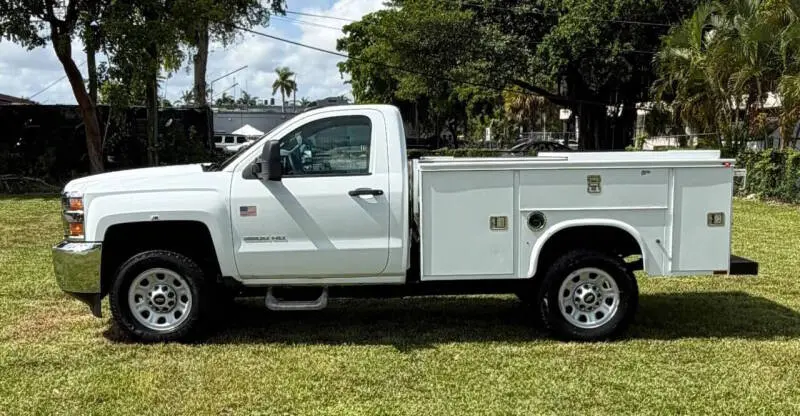
This shows up most clearly in work use. A contractor pulling a mid-size utility trailer may never need a 2500 HD in his life. Someone regularly towing a loaded car hauler or a skid-steer trailer will hit the 1500’s limits fast, and at that point it’s worth a look at our utility and service-body trucks built on the heavier platform.

Silverado 1500: Built for Everyday Driving and Moderate Work
Good fit for daily commuting, general hauling, weekend boat or camper towing, light construction and trades work, and small-business use where towing happens now and then rather than every day.
Silverado 2500 HD: Built for Heavy Work
Good fit for frequent heavy towing, equipment trailers, gooseneck or fifth-wheel campers, commercial hauling, and any job where you’re regularly at or past what a 1500 can rate for.
Why the 2500 HD Is a Different Truck, Not Just a Bigger One
The gap between these two isn’t only about power. It’s structural. In federal weight-class terms, the Silverado 1500 sits in Class 2A, with a GVWR of roughly 6,800 to 8,500 lb. The 2500 HD moves into Class 2B/3, with a GVWR up to roughly 10,000 lb or more. That higher rating comes from a heavier-gauge frame, larger front and rear axles, upgraded brakes, and a suspension built to carry sustained heavy loads without sagging. It’s not a bigger engine bolted to a 1500 chassis; it’s a different truck underneath. That’s also why the 2500 HD rides stiffer when it’s empty. The suspension is tuned for the load it’s built to carry, not for comfort with nothing in the bed.
The 2500 HD’s extra capability doesn’t come from the engine alone. It comes from the whole platform, and that starts with the engine.
Engine and Performance Comparison
Silverado 1500 Engine Options (2026)
| Engine | Horsepower | Torque | Notes |
|---|---|---|---|
| 2.7L TurboMax (standard on most trims) | 310 hp | 430 lb-ft | Standard engine with surprisingly strong low-end torque |
| 5.3L EcoTec3 V8 | 355 hp | 383 lb-ft | Balanced daily-driver V8 |
| 6.2L EcoTec3 V8 | 420 hp | 460 lb-ft | The path to the truck’s highest towing rating |
| 3.0L Duramax diesel (available) | 305 hp | 495 lb-ft | Best fuel economy under load, up to 28 mpg highway |
With either the 6.2L V8 or the Duramax 3.0L diesel and the Max Trailering Package, the 1500 reaches its 13,300 lb ceiling. The base TurboMax tows closer to 9,500 lb, and the 5.3L sits around 11,300 lb. So when you hear “a Silverado 1500 can tow 13,300 lb,” that’s true for specific configurations only, not for the lineup as a whole.
Silverado 2500 HD Engine Options (2026)
| Engine | Horsepower | Torque | Max towing (config dependent) |
|---|---|---|---|
| 6.6L gas V8 (standard) | 401 hp | 464 lb-ft | About 18,700 to 19,080 lb |
| 6.6L Duramax diesel (available) | 470 hp | 975 lb-ft | Up to about 22,420 lb |
Here’s the gap most comparison articles skip. The gas 2500 HD and the diesel 2500 HD are really two different towing trucks, not one truck with an optional upgrade. If your loaded trailer regularly runs 16,000 to 19,000 lb, the standard gas 6.6L likely covers you at a much lower purchase and maintenance cost. Past that, the diesel’s 975 lb-ft is what keeps the truck settled on grades and at low RPM with a heavy trailer behind it. For a closer look at what that choice actually costs over time, our guide to gas vs. diesel cost of ownership for work trucks breaks it down.
Which Engine Makes Sense for Your Work?
Here’s a rough way to translate specs into your actual trailer:
- Small utility trailer, ATV or UTV trailer, single-axle boat under 5,000 lb loaded: any Silverado 1500 engine handles this without strain.
- Mid-size travel trailer or dual-axle boat, 7,000 to 10,000 lb loaded: a 1500 with the 6.2L V8 or Duramax diesel, properly equipped.
- Large fifth-wheel RV, car hauler with a vehicle loaded, or dual-axle equipment trailer, 12,000 to 18,000 lb loaded: a 2500 HD gas is usually enough.
- Heavy equipment trailers, large livestock trailers, or gooseneck loads near 20,000 lb and up: a 2500 HD Duramax diesel.
These are rough guides, not ratings. Weigh your actual loaded trailer if you can (a scale ticket tells you more than any spec sheet) and check the tow rating for your exact configuration.
Engine and towing numbers get most of the attention, but for a lot of buyers, payload, not towing, ends up being what actually decides whether the 1500 is enough.
Towing Capacity: Silverado 1500 vs. 2500 HD
How Much Can the Silverado 1500 Tow?
Up to 13,300 lb when properly equipped. The actual rating depends on engine, cab, bed, drivetrain, axle ratio, and whether the Max Trailering Package is fitted. The same nameplate can range from roughly 9,500 lb to 13,300 lb depending on the build.
How Much Can the Silverado 2500 HD Tow?
Roughly 18,700 to 19,080 lb with the standard gas V8, and up to about 22,420 lb with the Duramax diesel and the right axle and package combination. Figures shift with cab, bed, and hitch type, and gooseneck or fifth-wheel setups typically rate higher than conventional hitches.
Why Maximum Towing Capacity Isn’t the Whole Story
The advertised max is a best-case number for one specific configuration. Your real number depends on the loaded, not empty, trailer weight, the tongue or pin weight, the passengers and cargo already in the truck, any hitch equipment you’re running, and how much of the GCWR (gross combined weight rating) the truck itself is already using.
Towing is only half the equation. If you regularly carry tools, materials, or passengers in the truck itself, especially with a gooseneck or fifth-wheel where pin weight lands right in the bed, payload becomes the limiting factor before towing ever does.
Payload Capacity: Which Silverado Can Carry More?
The Silverado 1500 offers up to 2,260 lb of maximum available payload. Interestingly, the lightest engine, the TurboMax, actually carries the most, since payload comes down to curb weight more than power.
The Silverado 2500 HD offers up to roughly 3,979 lb with the gas 6.6L V8, and about 3,715 lb with the Duramax diesel. The diesel’s extra engine weight over the front axle is what accounts for the lower payload ceiling compared to gas, even though the diesel tows more. Confirm the exact figure on the door-jamb sticker for whichever build you’re considering.
In plain terms, towing capacity is what the truck can pull, and payload is what it can carry. A gooseneck or fifth-wheel trailer converts a good chunk of “towing” into “payload,” because the pin weight sits right over the rear axle, which is exactly where the 1500’s lower payload ceiling can bite even when the towing number looks fine. If your work leans more on payload than towing, it’s worth comparing against our flatbed and service-body inventory, where bed configuration is built around exactly this trade-off.
Once towing and payload are both on the table, the next question is how the truck actually lives day to day, since most trucks spend more time driving empty than towing anything at all.
Which Silverado Is Better for Daily Driving?
The Silverado 1500 rides more comfortably unloaded and is the better default daily driver. The Silverado 2500 HD earns that title only when daily driving includes towing or hauling.
The 1500 is the more natural everyday truck. It has a broader engine lineup, lower curb weight, and a ride tuned for a truck that isn’t carrying HD-rated loads most of the time.
The 2500 HD can absolutely be driven daily, but its stiffer HD-rated suspension is tuned for load-bearing, not for unloaded comfort. It makes the most sense as a daily driver when daily driving includes towing or hauling, like a contractor pulling an equipment trailer to job sites every day.
The real question isn’t whether you can daily-drive a 2500 HD. You can. It’s whether you’ll actually use the capability you’re paying for, and riding on, every single day.
Which Silverado Is Better for Work?
The right truck for work comes down to how often you load it and how heavy that load is, not what kind of business you run. A well-equipped 1500 covers most moderate and occasional hauling. The 2500 HD is built for frequent heavy loads.
For construction and contractors, a 1500 covers tools, ladders, and a moderate trailer just fine. A 2500 HD starts to make sense once you’re regularly pulling heavy equipment or large enclosed trailers.
For towing boats and RVs, most recreational setups fit comfortably within the 1500’s rating. Check your loaded trailer weight before assuming you need HD capability.
For heavy equipment and commercial hauling, this is squarely 2500 HD territory, especially with the Duramax’s 975 lb-ft on tap.
For occasional towing, if heavy work only comes up now and then, a well-configured 1500 is usually the better overall purchase. There’s not much upside in buying HD capability you’ll only use twice a year.
Price and Ownership Costs
The Silverado 1500 costs less to buy, fuel, and maintain. The Silverado 2500 HD costs more up front and to run, but that premium buys structural margin the 1500 simply doesn’t have.
The 2026 Silverado 1500 starts at $36,900, and the 2500 HD starts at $45,900. Actual transaction prices vary by trim, engine, and options, and GM raised HD pricing by $500 to $600 across trims in December 2025, so it’s worth confirming current pricing before you budget. New isn’t the only path to either truck. Our used commercial truck buying checklist covers what to inspect, including engine blow-by, maintenance logs, and transmission wear, if you’re weighing a pre-owned 1500 or 2500 HD to bring the entry cost down.
Diesel engines, available on both trucks, generally cost more up front and to maintain, but they deliver better fuel economy and more low-end torque under load. Gas engines are simpler and cheaper to service, but they tow less.
For business buyers, trucks with a GVWR above 6,000 lb, which covers the 2500 HD and most 1500 configurations, can qualify for accelerated depreciation under Section 179, subject to annual IRS limits and how the vehicle is used. That’s general information, not tax advice, so confirm eligibility and current limits with a tax professional before it factors into your decision.
If your heaviest tow is a small trailer a few times a year, a 2500 HD is probably more truck, and more ongoing cost, than the job calls for. On the flip side, if you’re towing heavy equipment weekly, buying a 1500 to save money up front can end up costing more in strain, wear, and safety margin than it ever saved you.
Which One Should You Buy?
Choose the Silverado 1500 if daily driving is the priority, your loaded trailer stays comfortably under its rating, you want more configuration flexibility, and you don’t need HD-level payload or towing on a regular basis.
Choose the Silverado 2500 HD if you regularly tow 15,000 lb or more, need more than 2,260 lb of payload, use a gooseneck or fifth-wheel setup often, or your work depends on having heavy-duty margin as a matter of course rather than for the occasional big pull.
Before you decide, get these numbers for your own situation:
- Loaded (not dry) trailer weight
- Tongue or pin weight
- Passengers and cargo you typically carry
- Hitch type: conventional, weight-distributing, gooseneck, or fifth-wheel
- How often you’re towing near your max versus just occasionally
Compare those against the specific configuration you’re actually considering, not the lineup’s advertised maximum, using Chevrolet’s official trailering guide for exact ratings by cab, bed, and drivetrain.
Quick-Reference Decision Matrix
| Use Case | Recommended Truck | Why |
|---|---|---|
| Daily commuting, light utility | Silverado 1500 | Better fuel economy, comfortable unloaded ride, easier to park and maneuver |
| Recreational towing (boat, travel trailer) | Silverado 1500 (6.2L V8 or diesel) | Covers most loaded trailers up to about 13,000 lb with room to spare |
| Occasional heavy hauling, mixed-use contracting | Silverado 1500 or 2500 HD gas | Depends how close you run to the 1500’s ceiling, so check your loaded weight first |
| Frequent heavy equipment or large enclosed trailers | Silverado 2500 HD (gas) | Handles 16,000 to 19,000 lb loads without the diesel premium |
| Commercial or gooseneck hauling near 20,000 lb and up | Silverado 2500 HD (Duramax diesel) | The highest torque and towing ceiling in the lineup |
Is a Silverado 2500 better than a Silverado 1500? Not across the board. The 2500 HD offers more towing and payload capability, but the 1500 is generally the better fit for daily driving, moderate hauling, and lighter towing. The right truck comes down to your actual loaded trailer weight and payload needs, not which one sounds more capable on paper.
How much more can a Silverado 2500 HD tow than a 1500? The 1500 tops out around 13,300 lb. The 2500 HD ranges from roughly 18,700 lb with the gas engine to about 22,420 lb with the diesel, depending on configuration, a gap of roughly 5,000 to 9,000 lb depending on engine choice.
Is the Silverado 1500 enough for towing? For most recreational and light-commercial towing, yes. A properly equipped 1500 handles up to 13,300 lb. Whether it’s enough for you comes down to your loaded trailer weight, payload needs, and how often you’ll be running close to that ceiling.
What is the main difference between the Silverado 1500 and 2500 HD? The 1500 is a light-duty pickup built for balance across daily driving, towing, and payload. The 2500 HD uses a heavier-duty chassis, suspension, and drivetrain specifically for higher and more consistent towing and payload capability.
Which Silverado is better for commercial work? It depends on the load. Moderate hauling and light trailers suit a well-equipped 1500 just fine. Frequent heavy equipment, large trailers, or high payload needs point toward the 2500 HD.
Should I buy a 1500 or 2500 HD for occasional towing? If your trailer comfortably fits within the 1500’s rating and towing only comes up now and then, the 1500 is usually the more practical and economical choice. Move up to the 2500 HD if that “occasional” tow is still very heavy, or if you’re also carrying significant payload at the
Final Thoughts
There’s no version of this decision where bigger automatically means safer. A 2500 HD you never actually load to its rating is just a more expensive, stiffer-riding 1500. And a 1500 pushed past its real limits isn’t saving you money either. It’s just moving that cost from the sticker price onto your brakes, your transmission, and your margin of safety on the road.
The one number worth nailing down before you shop is your actual loaded trailer weight, not the trailer’s dry weight, and not the truck’s advertised maximum. Everything else here exists to help you turn that one number into the right platform, the right engine, and whether gas or diesel is worth paying for given how you’ll actually use the truck.
If you’re ready to compare real trucks instead of specs on a page, take a look at our full-size and utility truck inventory. New and used listings get updated regularly, and our team is happy to walk through configuration and payload numbers on the specific unit you’re looking at.