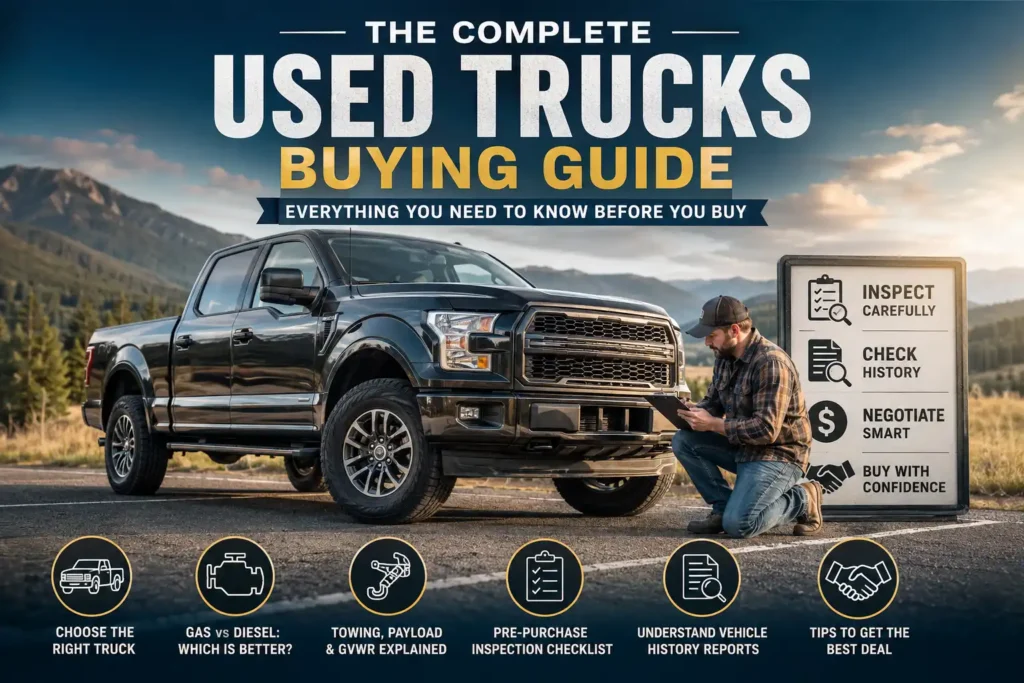
Buying one of the many used trucks on the market today can be one of the smartest choices in the U.S. vehicle market. You avoid the steepest years of depreciation, you can review proven reliability data instead of relying on guesswork, and you may pay 20% to 50% less than you would for a comparable new truck. This guide walks you through everything you should know before spending your money, including how to set a budget, choose the right truck type, cab, and bed, compare gas and diesel engines, inspect the truck properly, review its history, and negotiate a fair deal.
Why Buying a Used Truck Can Be a Smart Investment
New full-size pickups can now cost between $50,000 and $70,000 once you add a crew cab, four-wheel drive, and a mid-tier trim. A 3-year-old version of the same truck and trim may sell for 35% to 45% less, based on typical Kelley Blue Book and Edmunds pricing patterns for models such as the F-150, Silverado 1500, and Ram 1500.
Trucks also tend to hold their value better than many other types of vehicles. The Toyota Tacoma regularly ranks among the strongest resale performers in the midsize segment, while full-size trucks such as the F-150, Silverado, and Ram 1500 often remain above the industry average for 5-year resale value.
Buying used gives you several practical advantages over buying new. You can compare different engines, trims, and mileage ranges across five or more model years instead of being limited to one current lineup. You can also review real reliability information from existing owners rather than taking a chance on a model that has not yet built a track record. Insurance is often 10% to 30% cheaper on a used truck as well, mainly because the replacement cost is lower.
Depreciation Curves: Why Used Beats New
A new truck can lose 20% to 30% of its value during the first year alone, a drop often described as the “new car tax.” By the third year, total depreciation may reach 40% to 50%. When you buy used, the first owner has already absorbed much of that loss.
Depreciation usually happens in four stages. The first year brings the sharpest decline. Years two and three add another 15% to 20% in lost value, which is still faster than the long-term average. From years four through seven, depreciation often slows to around 5% to 8% a year for dependable models such as the Tacoma, F-150, Silverado, and Ram 1500. Once a truck passes 100,000 miles, its condition and maintenance history usually matter far more than its age.
For many buyers, the ideal range is a truck that is 3 to 7 years old with 40,000 to 100,000 miles. At that point, the truck has already passed through the steepest part of its depreciation while still having plenty of useful life ahead.
Define Your Needs Before Shopping
Before you start looking through listings, be clear about how you will actually use the truck. Many buyers skip this step, which is why some end up paying for capability they never need, while others choose a truck that cannot handle the work. Think about how many miles you drive each week, whether the truck will carry passengers or mainly be used for work, how often you plan to tow, what type of terrain you will cover, and whether fuel economy or maximum capability matters more to you.
Daily Driving vs. Work and Commercial Use
If the truck will mainly handle commuting and light errands, you probably do not need the biggest engine available. Good fuel economy, comfort, and easy parking will matter more. A midsize truck such as the Tacoma, Ranger, or Colorado often suits daily drivers better than a full-size pickup.
Work and commercial use change those priorities. Payload capacity and bed durability become more important than ride comfort. Check the condition of the bed liner, as spray-in liners usually hold up better than drop-in plastic liners over time. Find out whether the truck has a fleet or commercial history because that can affect its wear patterns and may appear on the vehicle history report. Compare the GVWR and payload rating shown on the door jamb sticker with the loads you expect to carry. If the cab will see heavy daily use, vinyl seating may also be more practical than cloth or leather.
Off-Road Adventures
Off-road driving calls for four-wheel drive, at least 8.5 inches of ground clearance, and factory skid plates that protect the oil pan, transfer case, and fuel tank. Trail driving and backcountry trips place much more stress on the suspension and undercarriage than normal commuting.
Pay attention to the approach, breakover, and departure angles because they determine which obstacles the truck can clear without striking the body or frame. Locking differentials, available on trims such as the TRD Off-Road, Chevrolet Z71, and Ford FX4, provide useful traction in mud, sand, and rocky conditions. Check the tire type and tread depth as well. A truck that already has good all-terrain or mud-terrain tires may save you the cost of replacing them soon after purchase. Any truck with a history of serious off-road use deserves a closer undercarriage inspection, which we discuss later in this guide.
Heavy Towing and Hauling
If towing is your main priority, start with the weight of your trailer rather than choosing the truck first. Calculate the trailer’s GVWR and expected loaded weight, then look for a truck with enough towing capacity to handle it comfortably. A margin of at least 20% can provide useful breathing room.
A factory tow package is important because it may include a heavier-duty transmission cooler, an upgraded alternator, a built-in trailer brake controller, and the correct wiring harness. The rear axle ratio also matters. A 3.73 or 4.10 ratio generally provides stronger pulling power than a 3.21 ratio, although it may reduce fuel economy by around 1 to 2 MPG. Diesel engines usually produce more low-end torque than gasoline engines, which matters more for towing than peak horsepower. Matching the truck to your actual trailer weight, rather than simply buying the biggest truck available, helps control fuel costs while still giving you enough capacity to tow safely.
How Much Should You Budget for a Used Truck?
A realistic truck budget should include five things: the purchase price, the payment method, insurance, fuel, and long-term maintenance. Buyers who plan for all five are less likely to face expensive surprises during the first year.
Purchase Price
Used truck prices can range from around $8,000 for a high-mileage work truck to $45,000 for a low-mileage certified pre-owned model. The final price usually depends on the model year, mileage, trim level, and title status. A budget below $15,000 often means looking at older models with more than 100,000 miles and basic trims. Between $15,000 and $30,000 may get you a truck that is 3 to 7 years old with 40,000 to 100,000 miles and a mid-level trim. Above $30,000, you are more likely to find certified pre-owned trucks with low mileage, higher trims, and factory tow packages.
Before you settle on a budget, it’s worth browsing our current inventory to get a real sense of what different price points actually get you.
Financing vs. Cash
Paying cash lets you avoid interest altogether. Financing spreads the cost over time but may add 5% to 10% in total interest over a standard 60-month loan. Credit unions often offer some of the most competitive used vehicle loan rates, sometimes 2 to 3 percentage points below dealer financing. Banks can also be a strong option, especially when you already have an established account. Dealer financing is usually the most convenient, but it may cost 1 to 3 percentage points more.
Insurance Costs
Insurance may cost between $1,200 and $2,400 a year on average, depending on the truck’s age, trim, your location, and your driving record. Full-size trucks often cost more to insure than midsize trucks because their repair and replacement costs are higher. Older trucks may cost less to cover for collision, while safety features such as forward collision warning may help you qualify for a discount. A clean three-year driving record can also lower your premium by 10% to 40%.
Fuel Expenses
Gas trucks often average 18 to 22 MPG combined, while diesel trucks may average 20 to 28 MPG combined. A truck driven 12,000 miles a year at 20 MPG, with fuel priced at around $3.50 per gallon, would use about $2,100 worth of fuel annually. Diesel may cost $0.20 to $0.50 more per gallon, which reduces part of its fuel economy advantage.
Long-Term Maintenance
Plan to spend around $600 to $1,200 a year on routine maintenance such as oil changes, brakes, tires, and fluids. It is also wise to keep $1,500 to $4,000 available in case a major repair comes up. Oil changes generally fall between every 5,000 and 7,500 miles, brake service may be needed every 30,000 to 50,000 miles, tires often last 40,000 to 60,000 miles, and transmission service is commonly recommended around 60,000 miles.
Choosing the Right Type of Used Truck
Used trucks generally fall into two broad comparisons: light-duty versus heavy-duty, and pickups versus commercial trucks. Choosing the right category matters because it affects everything from ride comfort to fuel economy and working capacity.
Light-Duty vs Heavy-Duty Trucks
Light-duty half-ton full-size trucks such as the F-150 or Silverado 1500 can tow up to around 13,000 lbs and work well for daily driving with moderate towing needs. Heavy-duty trucks, including three-quarter-ton and one-ton models such as the F-250 and Silverado 2500HD, can tow up to 36,000 lbs and are better suited to commercial work and large trailers. Heavy-duty trucks usually ride more firmly when empty because of their stiffer springs, but they can also be equipped with larger diesel engines such as the 6.7L Power Stroke or 6.6L Duramax. In normal daily driving, light-duty trucks may deliver 5 to 8 MPG more than heavy-duty models.
Pickup vs Commercial Trucks
Pickups are a good fit for personal use and lighter work, while commercial trucks such as box trucks, flatbed trucks, and utility service trucks are designed for businesses that regularly haul heavier loads. Commercial trucks usually have higher GVWR ratings, and vehicles above 26,001 lbs GVWR generally require a Commercial Driver’s License in most states. Pickups also tend to sell more quickly because they appeal to a much wider range of buyers than specialized commercial trucks.
Understanding Cab Styles
Most used trucks come in one of three common cab styles. The right choice depends on how much you value passenger space compared with bed length.
Regular Cab
Regular cab trucks have one row of seating for two to three people and no rear passenger area. This style works well for solo operators and contractors who would rather have a longer bed than extra seating.
Extended Cab
Extended cab trucks add a smaller rear seating area, usually behind half-size doors. They can seat four to five people, although rear legroom is limited. Ford often calls this layout a SuperCab, while Chevrolet may call it a Double Cab. It offers a practical middle ground between passenger room and cargo space.
Crew Cab
Crew cab trucks have four full-size doors and a proper rear seat. They can comfortably carry five to six people and usually provide rear legroom similar to a sedan. This style is a strong choice for families or anyone who regularly carries passengers, although it often comes with a shorter bed on the same overall wheelbase.
Choosing the Right Bed Length
Bed length affects cab size, cargo capacity, and the truck’s overall length. Most used pickups fall into one of three common bed sizes.
Short Bed
Short beds are usually around 5.5 feet long and are most often paired with crew cab trucks. They give priority to passenger space over cargo length. This setup works well for daily driving, tight parking spaces, and buyers who tow more often than they carry loose cargo.
Standard Bed
Standard beds are generally around 6.5 feet long and offer a useful balance between cargo space and overall size. They can handle most home improvement materials, including 4×8 sheets loaded at an angle.
Long Bed
Long beds are usually around 8 feet long and can carry full 4×8 sheets flat. They are a practical choice for regular commercial or trade use and are commonly paired with regular cab trucks in contractor and fleet configurations.
Gas vs Diesel Engines: Which Is Better?
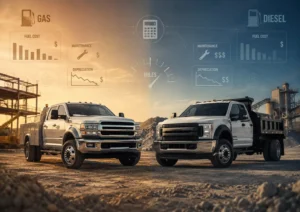
Gas engines are usually better suited to lighter towing and everyday driving, while diesel engines are often a better match for heavy towing and high-mileage commercial work. The right option depends on how often you tow, how many miles you drive each year, and how much you are prepared to spend on maintenance.
Diesel engines can produce anywhere from 400 to more than 1,000 lb-ft of torque, compared with around 300 to 430 lb-ft from a gas V8. That extra low-speed torque makes a noticeable difference when towing. Diesel engines may also deliver 20% to 30% better fuel economy than a comparable gas engine under the same load. The trade-off is the higher purchase and maintenance cost. Diesel trucks can cost $8,000 to $12,000 more upfront and may cost 30% to 50% more to maintain, mainly because of systems such as the DPF, DEF system, and EGR valve.
If you tow less than 8,000 lbs and drive fewer than 15,000 miles a year, a gas engine will often cost less overall. If you regularly tow more than that or drive more than 20,000 miles a year, a diesel may recover its higher upfront cost through better towing performance and fuel efficiency.
Towing Capacity, Payload and GVWR Explained
These three figures are often confused, and misunderstanding them can lead to overloading, longer stopping distances, and poor handling. Towing capacity is the maximum weight the truck can pull behind it. Payload capacity is the maximum weight it can carry in the cab and bed, including passengers, cargo, and trailer tongue weight. GVWR is the maximum total weight of the truck and everything it carries, not including the trailer itself.
Always check the door jamb sticker for the exact payload and GVWR rating of the specific truck you are considering. Published figures can vary by 1,000 to 3,000 lbs depending on the cab size, bed length, engine, and other options, even within the same model.
How Many Miles Is Too Many?
Mileage alone does not tell you how much life a truck has left. Maintenance history is usually a much better indicator. A truck with 150,000 miles and complete service records can be a safer purchase than one with 60,000 miles and no paperwork.
A truck with fewer than 60,000 miles is generally considered lower risk and may still have some factory powertrain warranty remaining. Between 60,000 and 150,000 miles, the risk is moderate, so you should review the service history carefully and arrange a proper inspection. Above 150,000 miles, pay particular attention to major services such as timing components and transmission maintenance. With consistent care, diesel engines may run beyond 300,000 miles, compared with the 200,000 to 250,000-mile range often associated with gasoline engines.
Best Used Truck Brands for Reliability
Toyota, Ford, and Chevrolet regularly perform well in used truck reliability rankings based on J.D. Power dependability studies and Consumer Reports owner surveys.
The Toyota Tacoma remains one of the strongest choices in the midsize category and holds its resale value extremely well. The Ford F-150 also performs well overall, particularly with the 5.0L V8, although higher-mileage EcoBoost V6 models should be checked for cam phaser issues. The Chevrolet Silverado 1500 is known for the durability of its 5.3L V8, but buyers should inspect high-mileage models for Active Fuel Management lifter wear. The Ram 1500 offers one of the most comfortable rides in the segment and a dependable Hemi V8, although some older 8-speed transmissions have more reported issues than comparable Ford or Chevrolet units.
The 5-Minute Pre-Purchase Inspection Checklist
Check these ten areas before taking the truck for a test drive. A serious problem in any one of them may be enough to rule out the vehicle and save you from wasting more time.
Exterior: Check the panel gaps, paint consistency, and glass date codes. Mismatched paint or uneven gaps often suggest previous collision repairs.
Interior: Test every window, seat adjustment, and dashboard warning light. Any light that remains on after the engine starts may point to an unresolved sensor or system problem.
Engine bay: Look for fluid leaks, a dirty or milky oil cap, and any non-factory wiring. A milky oil cap may be a sign of a failing head gasket.
Suspension: Push down on each corner of the truck and let go. If it continues bouncing more than once, the shocks or struts may be worn.
Brakes: Look through the wheel spokes to check the rotor thickness and brake pad wear. Deep grooves or heavily worn rotors usually mean replacement will be needed soon.
Tires: Check the tread depth and wear pattern on all four tires. Uneven wear on one side often points to an alignment or suspension issue.
Undercarriage: Look for fresh welds, bent components, and fluid leaks. Fresh undercoating in one isolated area may be hiding frame damage or a previous rust repair.
Frame: Inspect the frame rails for rust-through, especially near the rear axle and control arm mounts. Light surface rust is common on an older truck, but flaking rust or visible holes are serious warning signs.
Rust: Look closely at the wheel wells, rocker panels, and bed floor. Trucks from Rust Belt states in the Northeast and Midwest generally face a higher corrosion risk than trucks from dry climates.
Electronics: Test the 4WD system, backup camera, and infotainment system. If the 4WD does not engage correctly, the issue may involve the transfer case or actuator, and you should confirm it during the test drive.
How to Read a Vehicle History Report
Get the vehicle history report before you schedule a test drive. Focus on five main areas: the VIN, accident history, service records, ownership history, and title status.
VIN checks: Make sure the VIN matches on the dashboard plate, driver’s door jamb, and engine block stamping. A mismatch may indicate fraud or a salvage rebuild.
Accident history: Review the number and severity of reported accidents. Carfax and AutoCheck gather information from insurance claims, repair shops, and police reports, although not every accident is reported. Treat the report as an important source of information, but not a complete guarantee.
Service records: Look for consistent maintenance intervals, especially for oil changes. Gaps of two years or more may point to delayed or neglected maintenance.
Ownership history: Check how many owners the truck has had and whether it was used as a fleet, rental, or lease vehicle. One or two long-term owners with no fleet history may suggest more consistent care than a truck that has changed hands several times.
Title status: Pay attention to four common title types: clean, salvage, rebuilt, and lemon buyback. A salvage or rebuilt title may reduce resale value by 20% to 40%, even after the repairs pass inspection.
Taking a Proper Test Drive
Cover all six of these areas before making an offer. Some issues only appear at highway speed or when the truck is under real driving conditions, not while it sits idling in a parking lot.
City driving: Test acceleration from a stop and pay attention to low-speed steering. Hesitation during acceleration may point to a transmission or fuel delivery issue.
Highway driving: Drive between 55 and 70 MPH for at least ten minutes. Vibration through the steering wheel at highway speed can indicate a tire balance, alignment, or driveline problem.
Braking performance: In a safe and empty area, brake firmly from 40 MPH. If the truck pulls to one side or the brake pedal pulses, the rotors may be worn unevenly or a caliper may be sticking.
Steering feel: Check how much the steering wheel moves before the tires respond. More than about two inches of free play may indicate worn steering components.
Transmission behavior: Accelerate from 40 to 70 MPH and watch for shuddering or delayed shifts. A shudder in this range may indicate torque converter clutch wear, which is more common in high-mileage automatic transmissions.
Four-wheel drive test: Engage 4HI and 4LO in a safe area at low speed. Listen for grinding and watch for warning lights. If the system fails to engage, the problem may involve the transfer case motor or actuator, which can cost around $300 to $1,200 to repair.
Dealer vs Private Seller: Which Should You Choose?
Dealers often provide financing support and warranty options, while private sellers usually offer a lower price with fewer protections. A truck sold privately may cost 10% to 15% less than the same model at a dealership. Dealers may include a limited warranty or offer an extended warranty, while most private sales are completed as is. Dealers also usually handle title transfers and registration paperwork, while the buyer is responsible for those steps in a private transaction.
Certified Pre-Owned Trucks: Are They Worth It?
Certified Pre-Owned trucks go through a manufacturer inspection and come with extended warranty coverage. They usually cost 5% to 10% more than a similar non-certified truck. For buyers who value added protection and peace of mind more than getting the lowest possible price, that premium may be worthwhile.
Most CPO programs include a 100 to 150-point inspection completed by a manufacturer-trained technician. They may extend the original factory warranty by 1 to 2 years or 12,000 to 24,000 miles. Many programs also exclude trucks with branded titles or major reported accidents, giving buyers an extra level of screening that is not normally available in a private sale.
Common Used Truck Buying Mistakes to Avoid
The same five mistakes affect buyers again and again, and each one can add significant costs after the purchase.
Skipping a professional inspection is one of the biggest mistakes. A $100 to $200 inspection may uncover problems that could cost $1,500 or more to repair later. Ignoring the vehicle history report is another major risk. A $25 to $40 report can reveal accident or title issues that a basic walk-around may miss. Buying more towing capacity than you need can increase fuel and insurance costs without giving you any real benefit. Many buyers also underestimate maintenance expenses, so plan to spend $600 to $1,200 a year in addition to the purchase price, even with a dependable truck. Finally, rushing the purchase weakens your negotiating position. Comparing at least three similar listings before buying gives you a much better understanding of the market.
How to Negotiate the Best Deal
A good negotiation depends on three things: the inspection findings, comparable listings, and a firm walk-away price decided before the discussion begins.
Use the actual inspection results to support your offer. Specific repair costs for tires, brakes, or fluid leaks give you a clear reason to ask for a lower price. Bring two or three comparable listings to show how the truck compares with similar options. Decide on your maximum price before negotiating so that you do not talk yourself into spending more than you planned.
Essential Paperwork Checklist Before Purchase
A completed purchase should include six important documents: the title, a bill of sale, maintenance records, proof that recalls have been completed, a lien release when needed, and the paperwork required for registration.
Make sure the name on the title matches the seller’s identification and that the VIN matches the truck. Get a bill of sale that includes the agreed price, sale date, and both signatures. Ask for maintenance records covering at least the previous two to three years. Check the NHTSA VIN lookup tool to confirm recall status. If the seller financed the truck and still owes money, make sure you receive a valid lien release. Spare keys and the owner’s manual are not legally required, but it is still worth asking for them because replacing either one can be surprisingly expensive.
Maintenance Tasks to Complete Immediately After Buying
During the first 30 days, complete these five tasks to establish a clear maintenance baseline, regardless of what the seller has told you about the truck’s service history.
Arrange an oil and filter change, along with a complete fluid check covering the coolant, transmission, brakes, and power steering system. Rotate the tires and check the pressure so that future wear remains even. Have the battery load-tested to identify weakness before it leaves you stranded. Finally, request a full OBD-II diagnostic scan. It may reveal stored fault codes that never triggered a warning light on the dashboard.
Frequently Asked Questions
Is buying a used truck worth it?
Yes. Used trucks may cost 20% to 50% less than new ones, and a well-maintained truck can still have many years of useful life ahead.
What mileage is too high for a used truck?
There is no fixed cutoff. A truck with 150,000 miles and complete service records may be a safer choice than one with 60,000 miles and no maintenance history.
Should I buy from a dealer or private seller?
Dealers may provide warranty protection and handle much of the paperwork, while private sellers often offer a lower price with fewer protections. The better choice depends on your budget and how confident you are in the inspection.
What paperwork should I ask for?
At minimum, ask for the title, a bill of sale, maintenance records, and a lien release when one is required.
Can I negotiate the price?
Yes. Inspection findings and comparable listings may help bring the asking price down by 5% to 10%.
Are certified used trucks worth it?
They can be worthwhile for buyers who value warranty coverage and a manufacturer-backed inspection. You may pay 5% to 10% more, but you receive added protection and greater peace of mind.
Final Verdict: Ready to Shop?
A good used truck purchase comes together when you confirm five things: the title is clean or clearly disclosed, the maintenance history is documented, the truck passes an inspection, the test drive feels right, and the price matches the market. When all five are in place, you are more likely to leave with a truck that genuinely suits your needs instead of simply choosing the one that fits your budget.
Compare at least three similar listings, get the vehicle history report early, and arrange a professional inspection before making an offer. Follow those three steps, and you will be better prepared than most buyers who walk into the process.
If you’d like help comparing your options in person, visit AFT Sales and we can walk you through inspection reports, service history, and current inventory.