Buying a forestry truck is not like buying a pickup off a dealer’s lot. When searching for forestry trucks for sale, one incorrect boom certification or missed inspection could lead to thousands of dollars in repairs before the truck even starts earning money. This guide explains where to shop, what new and used forestry trucks typically cost, and which common mistakes can affect even experienced buyers, helping you invest your budget in the right truck instead of learning the hard way.
Where to Buy Forestry Trucks
Three types of sellers dominate this market, and each comes with different tradeoffs. Specialty marketplaces like ForestryTrader and TruckPaper carry hundreds of active listings at any given time. ForestryTrader alone shows an average price of $64,172 to purchase forestry bucket trucks, with active inventory ranging from $7,199 all the way up to $469,979 depending on condition and specs.
Full-service dealers are the second option, and they lean heavily on convenience. Custom Truck One Source has served the forestry industry for over 30 years and works with your cash flow, offering in-house financing with flexible payment terms of up to 84 months. That kind of support matters if you’re financing your first truck and don’t want to juggle a separate lender.
Auction platforms round out the field. IronPlanet lets you browse an inventory of used bucket trucks for sale at auction from brands like Chevy, Ford, and Altec, which can mean lower prices but also less certainty about a truck’s maintenance history. Regional dealers like Baskin Truck Sales and Jim Reed Truck Sales also carry solid inventory and are worth calling directly, since not everything makes it onto national listing sites.
What’s on the Market Right Now
Not every “forestry truck for sale” listing means the same thing, and knowing what configuration you’re actually shopping for saves a lot of wasted calls. If you’re still deciding between a bucket truck, dump truck, or service truck, our complete forestry trucks guide walks through each type. Once you know what you need, here’s how that plays out in current inventory.
New Forestry Trucks for Sale
New inventory moves fast, and most of what’s currently listed centers on Freightliner and Ford chassis paired with Terex or Versalift booms. If you’re weighing forestry-specific builds against general commercial models, our new trucks for sale guide covers pricing and financing across the broader lineup. Current new listings include a brand new Freightliner M2106 4×2 upfitted with a Terex XT PRO 60-BOC-F-PC forestry bucket and chipper body, alongside compact options like a Forestry LT40 on a Ford F-550 4×4 that gives you a compact, under-CDL solution that still delivers real aerial capability.
New truck pricing depends heavily on chassis size, boom height, and insulation. A 2025 Ford F-750XL with a 33,000 lb GVWR and 6.7L Power Stroke diesel represents a common mid-range new build, while smaller F-550-based units with 40-foot booms sit at the budget end of the new market. If you need something specific, most dealers can build to order, though lead times for custom configurations often stretch into months.
Used Forestry Trucks for Sale
Used trucks make up the bulk of the market, and pricing varies by an enormous margin depending on age, hours, and boom condition. Nationwide listings currently range from $7,199 to $469,979 for forestry bucket trucks, which tells you just how important it is to compare specs rather than shopping by price alone.
Ford F-750 units are especially common on the used market: 118 new and used FORD F750 forestry bucket trucks currently range from $25,000 to $219,988, most equipped with either Altec LR756 or Terex Hi-Ranger booms in the 55–65 foot range. Older units, say a 2007 or 2011 model, can dip toward the bottom of that range if the boom inspection and dielectric testing are current, but skip that check and you’re gambling on a hidden repair bill.
Forestry Bucket Trucks for Sale
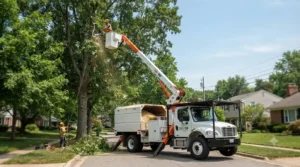
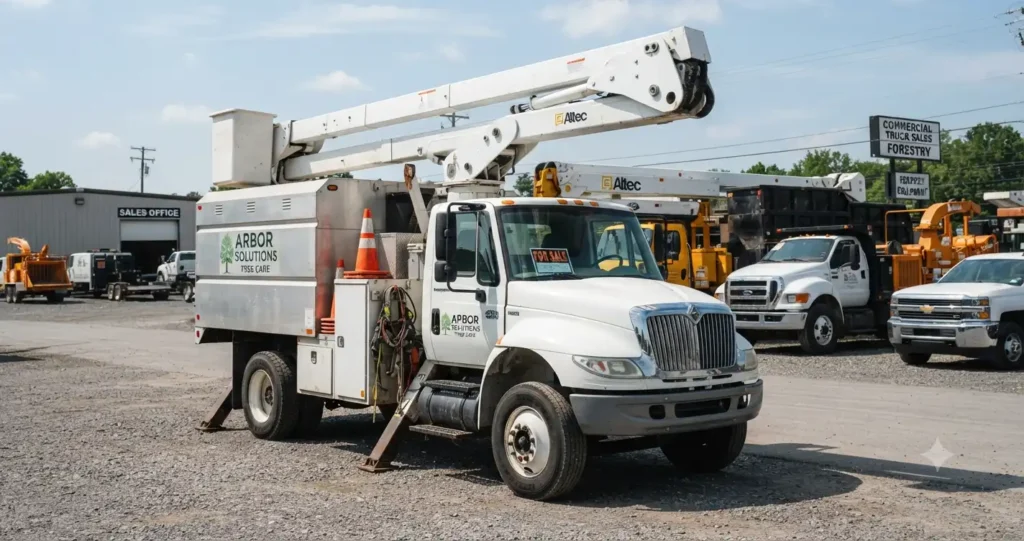
This is the single most searched configuration on the market. When you’re comparing listings, always confirm the boom brand and working height first: a “forestry bucket truck” listed without a specific boom model or height is a red flag worth asking about directly. Most platforms are rated to hold around 500 pounds, though some can support greater weight for heavy tools or a second crew member, and nearly all current listings include a falling object protection system (FOPS) over the cab. (For a full breakdown of boom types and configurations, see our forestry bucket trucks guide.)
Forestry Dump Trucks for Sale
Dump-configured forestry trucks show up less often in general searches but serve a very specific need: moving logs, mulch, and bulk debris that a chip box can’t handle efficiently. These are typically built on heavier chassis, like the Freightliner FL80 platform, and are often paired with an elevator-style boom for combined lifting and hauling capability. At AFT Sales, these specialized forestry dump trucks are selected to meet the demands of professional tree care, logging, and land-clearing operations.
Listings in this category frequently combine both functions in a single vehicle. One common configuration pairs a 75 ft elevator bucket with a chipper dump body on a Freightliner M2 106 chassis, giving crews lift height and debris hauling without needing two separate trucks on site. If your work involves heavier logs or larger volumes of debris than a standard chip box handles, this configuration is worth prioritizing over a standard bucket truck.
Elevator Forestry Trucks for Sale
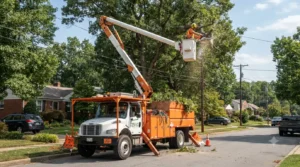
“Elevator” bucket trucks use a specific boom mechanism that lifts the platform straight up along a fixed track rather than swinging out on a traditional jointed arm, and they’re popular specifically for their extended vertical reach. Listings show dozens of these units at 75 ft working height, most built around the Altec LR760-E70 boom mounted on Freightliner M2 106 or Ford F-750 chassis.
Some elevator models push well past the standard range too. One listing describes an Altec AM900-E100 105ft Double Elevator Articulating Continuous Rotation Bucket Truck with a two-man bucket, built for utility and transmission-line work where standard forestry booms simply can’t reach. That’s a specialty unit, and pricing reflects it: expect a significant premium over a standard 61–65 foot forestry configuration.
75 ft Forestry Bucket Trucks for Sale
The 75-foot mark has become something of an industry ceiling for standard forestry work, and it shows up constantly across current listings. Multiple 2014–2018 Freightliner M2 106 units equipped with the Altec LR760-E70 boom, offering a 75 ft over-center elevator configuration with chipper dump bodies, appear repeatedly across major listing sites, suggesting steady turnover and healthy used supply in this exact configuration.
Rear-mount versions in this height class are worth knowing about too. The Terex XT Pro 60/70 Rear Mount bucket truck offers a 75 ft working height, an optional 20,000 lb front winch, dual hydraulic tool connections at the platform, and the shortest wheelbase in the market, a detail that matters enormously if you’re working tight residential streets despite needing serious height. When shopping this height bracket specifically, cross-reference the boom’s serial number and inspection date before committing, since a 75-foot boom with lapsed certification needs re-testing before it can legally go back to work.
Buying Checklist
Before you wire a deposit, run through this list, and if you’re new to buying commercial trucks generally, our complete truck buyer’s guide covers the broader fundamentals that apply beyond forestry equipment too:
- Verify the boom model and working height directly: don’t rely on vague listing titles; ask for the specific boom serial number.
- Check PTO hours alongside engine mileage. A truck with low road miles but heavy PTO cycling has still seen real hydraulic wear.
- Confirm the current boom inspection and dielectric test dates. A truck without recent documentation isn’t a bargain, it’s a liability.
- Ask about CDL classification and confirm the GVWR to know whether your driver pool can legally operate it.
- Compare chip box size against your actual debris volume: most run 10 to 30 cubic yards depending on chassis.
- Request maintenance records, not just a clean paint job. A well-documented truck beats a shiny one every time.
- Check for rust and frame damage on the underside, especially on trucks sourced from northern, salt-heavy states.
Financing Options
Most forestry truck buyers don’t pay cash upfront, and dealers know it. Custom Truck One Source offers in-house financing options with flexible payment terms of up to 84 months, which spreads the cost of a $150,000+ truck into manageable monthly payments rather than a single lump sum.
Third-party commercial lenders are common across listing platforms too. Many financing arrangements on marketplaces like ForestryTrader and TruckPaper assume a secured commercial-use loan transaction available for highly qualified commercial loan applicants, often structured around 60-month terms with a down payment requirement. Rates and terms vary significantly by credit profile, so it pays to get pre-approved before you start negotiating price: sellers take serious buyers more seriously when financing is already lined up.
Cost of Forestry Trucks
Pricing swings dramatically based on age, height, boom brand, and insulation. Here’s a realistic snapshot based on current market listings:
| Configuration | Typical Price Range |
|---|---|
| Used, 40–55 ft boom, older chassis | $17,600 – $50,000 |
| Used, 60–65 ft boom, mid-age chassis | $50,000 – $150,000 |
| Used, 75 ft elevator boom, newer chassis | $150,000 – $230,000 |
| New, standard forestry bucket configuration | $85,000 – $220,000+ |
| Specialty (105 ft, two-man, insulated) | $250,000+ |
For context, Ford F-750 forestry bucket trucks alone currently span $25,000 to $219,988 across active listings, which shows just how much boom height, insulation, and chassis year affect final price within a single model line. Don’t assume a bigger number always means better value: a newer truck with a shorter boom might suit your actual jobs better than an older 75-footer priced similarly.
Best Dealers and Manufacturers
A handful of names come up again and again across serious forestry truck listings. On the boom side, Altec, Terex, and Versalift dominate the market, with Altec’s LR756 and LR760-E70 models appearing across a huge share of current used inventory. Versalift tends to run slightly cheaper than comparable Altec units while offering competitive side reach, making it a common pick for budget-conscious buyers.
On the dealer side, M&M Equipment Auto Sales shows up repeatedly across multiple listing platforms with consistent inventory of 60–75 foot forestry units. Custom Truck One Source stands out for buyers who want financing and service bundled into one relationship, while regional players like Baskin Truck Sales, Jim Reed Truck Sales, and Cassone Truck & Equipment Sales are worth checking directly since their inventory doesn’t always sync perfectly with the big marketplaces.
If you’re specifically after log-hauling capability rather than an aerial lift, it’s worth cross-shopping self-loading log trucks and knuckleboom loaders as well, a different segment of the forestry market with its own set of go-to brands.
Mistakes to Avoid
Buying on price alone. A cheap truck with a lapsed boom certification can cost more in re-inspection and repair fees than a slightly pricier unit that’s already current.
Ignoring PTO hours. Mileage tells you about the road, not the boom, and the boom is where the real wear happens on a forestry truck.
Skipping a title and lien check. Some listings explicitly note “no title, bill of sale only,” which should immediately raise questions about the truck’s ownership history.
Overbuying on height. A 75-foot elevator boom looks impressive, but if 90% of your jobs need 50 feet, you’re paying for capacity that sits unused most days.
Not confirming CDL classification before purchase. Buying a truck over the 26,001 lb threshold without checking your driver pool first can leave an expensive truck sitting idle for lack of a licensed operator.
Frequently Asked Questions
Q: What’s the average price of a used forestry bucket truck? Around $64,172, though listings range from under $10,000 to nearly $470,000 depending on condition.
Q: What’s the difference between a standard bucket truck and an elevator forestry truck? An elevator model lifts straight up a fixed track for extended reach; a standard boom swings out on a jointed arm.
Q: Are financing options available for used forestry trucks? Yes, most dealers offer commercial financing, often 60-month terms, with some in-house options up to 84 months.
Q: What should I check before buying a used forestry truck? Boom inspection dates, PTO hours, and maintenance records matter far more than mileage or paint condition.
Q: Is it better to buy from a marketplace, dealer, or auction? Marketplaces offer the widest selection, dealers offer financing and support bundled in, and auctions can mean lower prices but less certainty about maintenance history: match the choice to how much hands-on vetting you’re able to do yourself.
Final Thoughts
Buying a forestry truck comes down to matching the right configuration to your actual job mix, then verifying the truck’s boom condition and paperwork as carefully as you’d check the engine. Price alone won’t tell you whether a listing is a good deal: the boom inspection date, PTO hours, and maintenance records will. Whether you go with a specialty marketplace, a full-service dealer, or an auction platform, working through the checklist above before you commit will save you far more than it costs in time.
Ready to see what’s available? Browse current forestry trucks for sale at AFT Sales, or reach out to our team for help matching a truck to your specific job requirements.